
How black ice forms on Spokane's freeze-thaw cycle
Most ice problems in Spokane don't come from a storm itself, they come from what happens after. Daytime sun melts the top layer of snow or a dusting of frost, that water runs downhill into low spots, tire tracks, or shaded patches, and once the temperature drops back below freezing overnight, it refreezes into a thin, often nearly invisible sheet. That's black ice: not literally black, just clear enough to look like wet pavement instead of ice, which is exactly why it's dangerous.
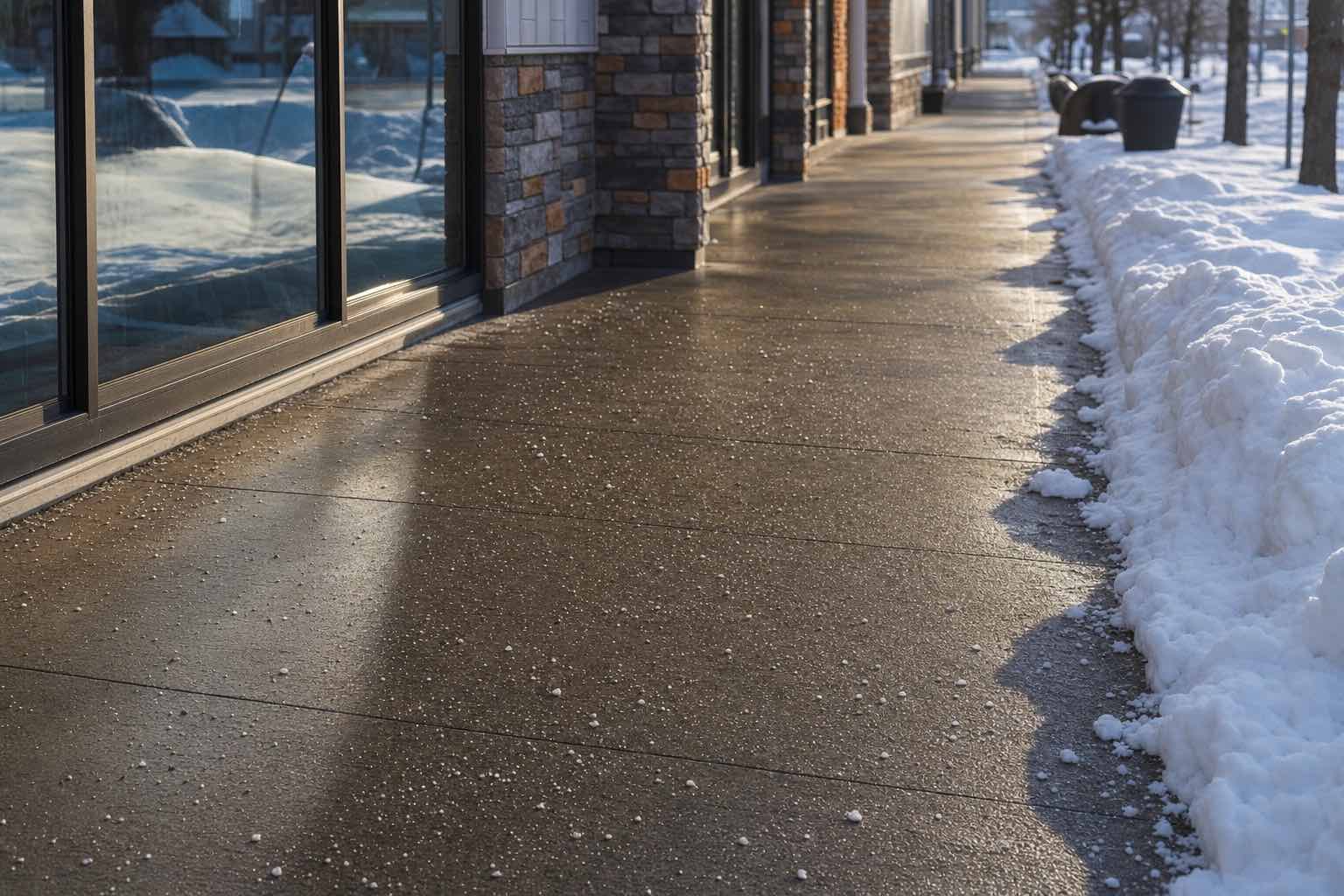
North-facing driveways and shaded stretches of walkway are the usual repeat offenders, since they get little or no direct sun through the winter months and stay in that melt-refreeze cycle far longer than a south-facing slope that dries out in an afternoon. Ice management is mostly about interrupting that cycle before it starts, not just chipping ice off after the fact.
Granular vs. liquid de-icers
Granular de-icer is the pellet form most people picture: it's spread over existing snow or ice and works by breaking the bond between the ice and the pavement underneath, so it can be cleared or melts off. It's a reactive tool, applied after ice or snow is already present.
Liquid de-icer works the opposite way. It's sprayed on pavement ahead of a forecasted freeze, lowering the freezing point of any moisture on the surface so ice never fully bonds in the first place. Pre-treating with liquid before a known freeze event is usually more effective, and often cheaper, than trying to break up ice that's already set, which is why commercial contracts increasingly build pre-storm liquid application into the plan rather than waiting to react.
Pet-safe and concrete-safe options
Standard rock salt does the job, but it isn't free of downsides: it can irritate paws on dogs and cats that walk across treated surfaces, and repeated seasons of exposure can contribute to surface damage on some concrete, particularly newer or lower-grade pours. Pet-safe and concrete-safe de-icer formulations exist as an alternative and can be specified for any residential or commercial job, usually at a modest cost premium over standard salt.
Sidewalks and who's responsible
The City of Spokane requires timely sidewalk clearing from adjacent property owners. Exactly what counts as timely, and what the enforcement looks like, is set by the city and can change, so check current city guidance rather than relying on secondhand information, including anything on this page. What we can do is fold sidewalk clearing into your residential or commercial plan so it happens on the same schedule as your driveway or lot, instead of being a separate thing you have to remember.
Sanding as a supplement
Sand doesn't melt ice, it adds traction on top of it. That makes it a useful supplement on steep grades, stairs, or heavily shaded stretches where a de-icer alone might not fully clear the surface before the next freeze cycle, but it's rarely the whole answer by itself. Most ice management plans pair sand with a granular or liquid de-icer rather than choosing one or the other.
Timing an ice management plan
Ice management works best as an ongoing plan rather than a one-time call after a bad morning. A property on a seasonal contract typically gets pre-storm liquid application worked into the same route schedule as plowing, so de-icer goes down ahead of a forecasted freeze without a separate request each time. Per-push and one-time customers can still get reactive de-icing after ice has formed, but pre-treatment is where the real advantage is: it's the difference between preventing a problem and cleaning one up after someone's already found it the hard way.
Ice management questions
Why does Spokane get so much black ice?
Black ice forms when Spokane's freeze-thaw cycle refreezes meltwater overnight: daytime sun melts surface snow, that water runs into low spots or shaded patches, and once temperatures drop back below freezing it refreezes into a thin, nearly invisible layer. North-facing and shaded driveways are the most common spots since they never fully dry between cycles.
What's the difference between granular and liquid de-icer?
Granular de-icer is solid pellets spread on existing ice or snow to break the bond with pavement, while liquid de-icer is sprayed ahead of a freeze to prevent ice from forming in the first place. Liquid works best as a pre-storm treatment; granular works best as a reactive treatment once ice has already set.
Do you offer pet-safe or concrete-safe de-icers?
Yes. Standard rock salt can irritate pet paws and, over repeated seasons, contribute to concrete surface damage, so pet- and concrete-safe alternatives are available on request for driveways, walkways, and areas where pets are regularly out. Ask about it when you request a quote so it's built into your service plan from the start.
Am I responsible for clearing the sidewalk in front of my house?
The City of Spokane requires timely sidewalk clearing from adjacent property owners; check current city guidance for the specific requirements that apply to your property, since rules can vary and are enforced by the city, not by us. We can include sidewalk clearing in a residential or commercial plan so it's handled on the same schedule as your driveway or lot.
Do you sand instead of using chemical de-icers?
Sand is available as an alternative or supplement to chemical de-icers, mainly for traction on packed ice rather than melting it. It doesn't lower the freezing point the way salt-based products do, so it's often paired with a de-icer rather than used alone, particularly on steep grades or heavily shaded stretches.
Get ahead of the next freeze
Request free quotes for de-icing on your property. A local provider may contact you about your request. Response time is up to that provider.