
Built for retail, office, and HOA properties
Commercial snow removal in Spokane covers a wider range of properties than most people think: retail strip centers, standalone office buildings, medical clinics, and HOA common areas all have different pressure points. A retail lot needs entrances and fire lanes cleared before opening. An office park cares more about the main drive and visitor parking. An HOA has to think about shared walkways, mailbox clusters, and whichever common area gets the most foot traffic. The route plan for each looks different, even if the underlying equipment is the same plow and spreader setup.
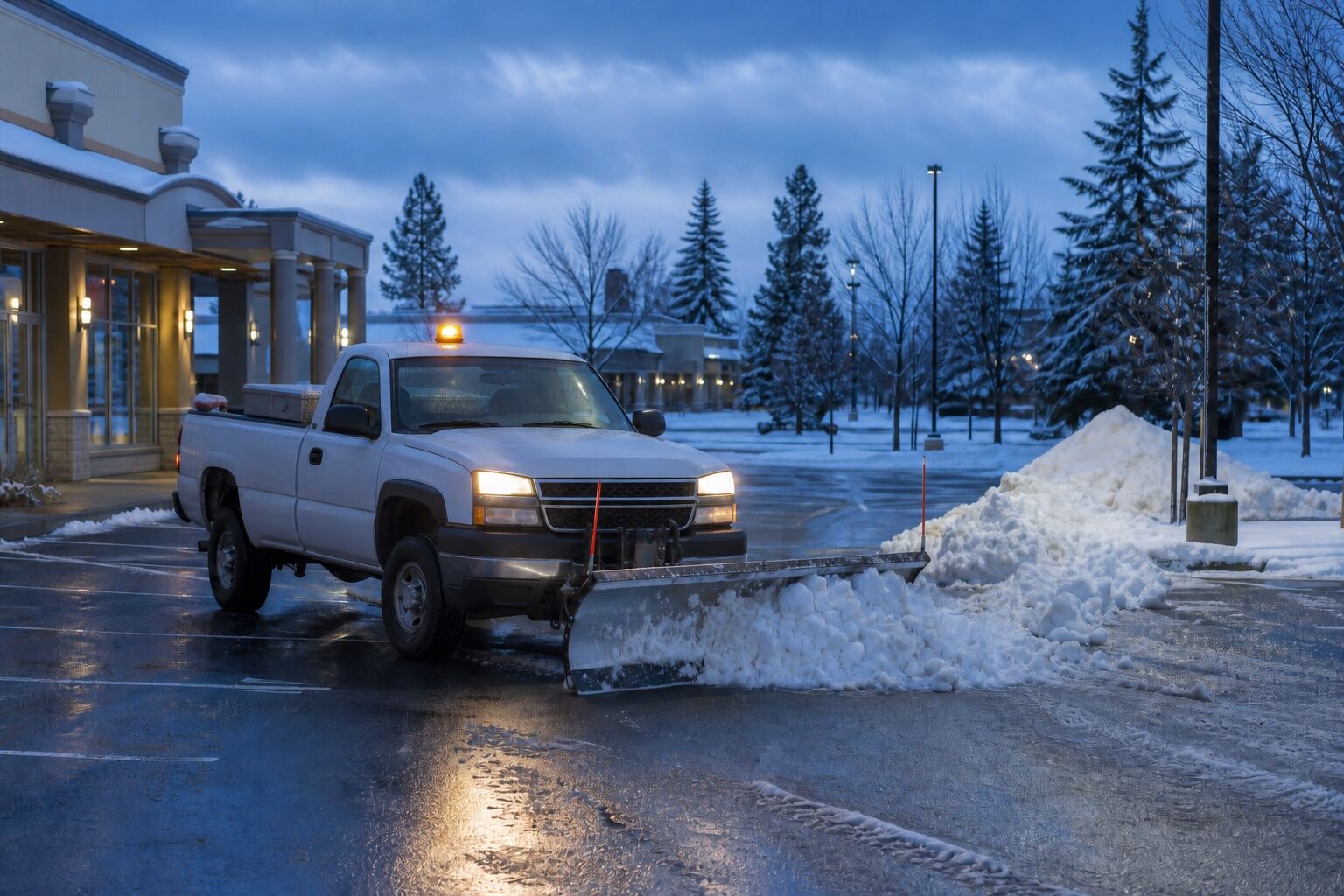
Liability and slip-fall exposure
Property managers carry real exposure here. A parking lot or walkway that ices over between storms is one of the more common sources of slip-and-fall claims on commercial property, and insurers increasingly want to see a documented, consistent snow and ice response plan on file, not just "someone gets called when it snows." That doesn't mean any contractor can eliminate your liability. It means a trigger-based response plan, applied consistently across the season, is the standard practice property managers and their insurers generally expect.
Documentation for property managers
Every commercial visit can be logged with a time stamp showing when a lot was plowed, when de-icer went down, and what conditions triggered the visit. That record is useful if a claim comes in and someone asks what was done and when. It's a service log, not a legal shield, and property managers should still keep their own inspection routines and talk to their insurer about specific coverage questions.
Pre-storm staging and de-ice bundles
A lot of commercial ice problems start before the snow even falls. When a freeze is forecast, applying de-icer ahead of time keeps ice from bonding to the pavement, which is far easier to prevent than to remove once it's set. Plow-and-de-ice bundles combine that pre-storm application with the reactive plowing that happens once snow actually accumulates, so a lot gets treated on both ends of a storm cycle instead of just after it.
Contract structures for commercial properties
Most commercial customers run on a seasonal contract priced by lot size, layout complexity, and expected trigger events for a typical Spokane winter. Per-push billing is available for smaller lots or properties with lighter traffic needs, but larger retail and office sites usually find a seasonal contract easier to budget, since snow removal cost then becomes a fixed line item rather than a variable one tied to how bad any given month turns out to be.
HOA-specific considerations
HOA properties add a layer that single-owner commercial sites don't have: a board that has to approve a budget line, and residents who all expect the same standard of clearing regardless of where their unit sits on the property. A good HOA contract maps every common walkway, guest parking row, and mailbox cluster individually rather than treating the whole property as one undifferentiated lot, since those are the spots that generate resident complaints when they're missed. Trigger depth and timing usually get set at the board level and applied consistently across the entire property.
Multi-tenant and mixed-use properties
Office parks and mixed-use buildings often have several separate entrances, loading docks, and tenant-specific parking areas that all need to be cleared on a schedule that matches when people actually arrive, not just whenever a crew gets to the property. Coordinating that timing with a property manager up front, including which entrances open earliest and which fire lanes have to stay clear around the clock, keeps a large site from having one tenant complain that their section was overlooked while another was cleared first. That coordination usually happens once, during setup, and then just carries through the rest of the season on the same route.
Commercial snow removal questions
How does commercial snow removal pricing work?
Commercial lots are typically priced on a seasonal contract based on square footage, layout complexity, and number of trigger events, with per-push and combined plow-plus-de-ice bundles available as alternatives. Contract structure depends on your risk tolerance: a flat seasonal rate protects against a heavy winter, while per-push can cost less in a light one.
Can you provide documentation for our property management records?
Yes. Time-stamped service records showing when a lot was plowed and de-iced can be provided for property managers who need a paper trail for insurance or liability purposes. This documentation shows service occurred; it is not a guarantee against claims, and property managers should maintain their own inspection logs as well.
Do you stage before a storm or only respond after?
Both, depending on the contract. Pre-storm staging means de-icer goes down ahead of a forecasted freeze so ice doesn't bond to the pavement in the first place, which is usually cheaper and more effective than removing ice after it forms. Reactive response after snowfall handles the plowing itself.
What size properties do you service?
We service retail centers, office parks, medical and professional buildings, and HOA common areas across Spokane's North Side. Lot size and layout, including how many entrances, fire lanes, and handicap-accessible routes need separate attention, factor into the route plan and pricing more than square footage alone.
Who is liable if someone slips on our lot after a storm?
Liability depends on your specific circumstances, your contract terms, and Washington premises liability law, so this isn't something we can answer generically. What we can do is maintain time-stamped service records and consistent trigger-based response, which property managers and their insurers typically want to see in place. Talk to your property insurer or attorney about your specific exposure.
Get your property on the commercial route
Request free quotes for your lot. A local provider may contact you about a seasonal or per-push option. Response time and price are up to that provider.